Saturday, April 30, 2016

Does God have no choice over natural evil?

On one view God allows various natural evils because they serve a useful purpose for the natural world. For example, what about tsunamis that kill people? Well this website says this (after talking about some earth science):

When earthquakes occur under the oceans, the plate's movement dissipates its energy through the ocean in the form of waves known as tsunami. When these waves make landfall, they can be up to 100 feet high and travel inland for several miles. The 2004 tsunami in the Indian Ocean caused widespread devastation to surrounding coastal areas, while killing over 200,000 people. A very large tsunami struck Japan, following a massive earthquake in 2011. We have already discussed the problems involved with stopping earthquakes and have determined that stopping them would result in a greater evil (lack of continental land masses and excessive solar radiation on the surface of the earth).

I’ll save my rebuttal for later, but first I’ll give a few other examples. Atheist philosopher William Rowe gave the example of a deer suffering a slow and painful death in a forest fire as a natural evil he argued that a good God would not allow.

Surely, a good God would want to prevent the suffering caused by fires.

As you learned in your elementary science classes (or Boy Scouts), fire requires three things—fuel, heat and oxygen. In most cases, the fuel is plant material. Obviously, God cannot eliminate plants, since all life is dependent upon the food and sequestered energy produced through photosynthesis.

Eliminating heat is problematic....One cannot eliminate oxygen from the environment

You get the idea. What about pain and suffering? From the website:

Atheist tend to assume that all pain, suffering, and death are bad or evil. However, physical pain is absolutely vital to our survival and well-being. If we felt no pain, we would do things to ourselves that could be very destructive.

One large problem with this is that God creating a universe of sentient creatures not susceptible to such pain and suffering seems to be within the realm of omnipotence. Why not create a world in which people are as invulnerable as Superman with there being no kryptonite? Moreover, what about heaven? Will people suffer horribly there because God can’t think of a way to do it better?

Thursday, March 31, 2016

Eyewitness Testimony and Miracles

I mentioned in my review of the William Lane Craig vs. Alex Rosenberg debate that the “eyewitness testimony is unreliable” objection is a bad one to use against e.g. arguments for the resurrection of Jesus. Here’s a somewhat obvious problem if eyewitness testimony is unreliable to the point where anything relying on eyewitness testimony should not be accepted as true: if you follow that rule consistently, then pretty much every fact of ancient history is tossed in the rubbish bin.

At the very least the “eyewitness testimony is unreliable” objection needs to be fine-tuned more; preferably there should be some explanation for why we shouldn’t trust eyewitness testimony in the case of miracles even though eyewitness testimony is often reliable in many other cases (remember, pretty much every scientific fact we have relies on eyewitnesses who recorded e.g. results of experiments; think of that next time you read a physics textbook). That’s what I’ll do in this article.

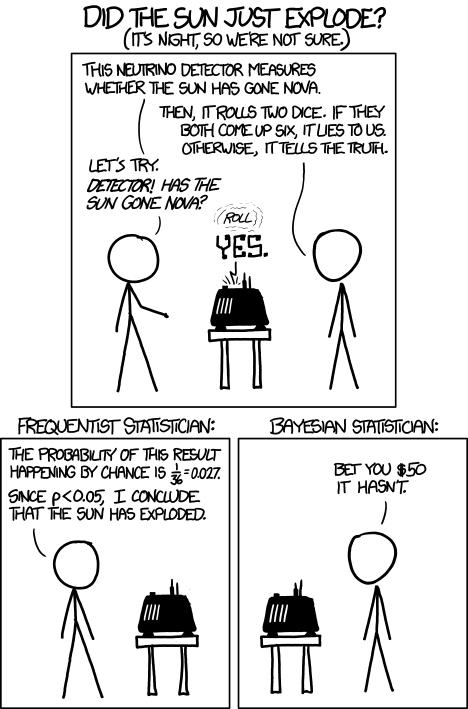
Happily, there’s an XKCD comic to help illustrate the idea. Behold:

In this case the neutrino detector serves as a representation for a generally reliable eyewitness (it’s accurate about 97.2% of the time), and the sun explosion represents a fantastical event with an extremely low prior probability. Don’t know what a prior probability is? Here’s one version of Bayes’ theorem:

P(H|E) =  P(H) × P(E|H)
P(E)

In this case, P(H) represents the prior probability. Let’s use the following symbolization key:

  • H = The sun exploded
  • ¬H = The sun did not explode.
  • E = The neutrino detector reports the sun has exploded.

Suppose there’s a one in a million shot that the sun exploded (I’m pretty sure that’s an overestimate, but this will suffice for our purposes).

P(H) =  1
1,000,000

The probability that our neutron detector is telling us a falsehood is 1 in 36. So on average, of the times that the sun does not explode, it will inaccurately report it 1/36 of the time. Thus:

P(E&¬H) =  1  ×  999,999  ≈ 0.027778
361,000,000

Of the times that the sun does explode, it correctly reports it 35/36.

P(E&H) =  35  ×  1  ≈ 0.00000097222
361,000,000

Note that since the sun not exploding is a far more likely event, the frequency of false positives (≈ 2.778% of the time) vastly outweighs the frequency of true positives (≈ 0.000097222% of the time) given that the neutrino detector reports the truth only 35/36 of the time. According to the law of total probability:

P(E) = P(E&H) + P(E&¬H) ≈ 0.027778

Also, given the following equation and plugging in the values above for P(E&H) and P(H):

P(E|H) =   P(E&H)  ≈ 0.97222
P(H)

Plugging in our values for Bayes’ theorem gives us this:

P(H|E) =  P(H) × P(E|H)  ≈ 0.000035
P(E)

In the XKCD comic, the “Frequentist Statistician” committed what’s called the base rate fallacy, concluding that the sun probably exploded because the “base rate” reliability of the neutrino detector seems (to this statistician) to suggest the sun probably exploded. The problem, as I suggested before, is that on average the frequency of false positives vastly outweighs the frequency of true positives. This sort of effect is known as the paradox of the false positive, a.k.a. the false positive paradox. Very roughly, this paradox is where false positives are more likely than true positives when the overall high reliability of the “test” (most of the times the test results accurately report the situation) might lead one to believe that a positive result (e.g. the detector saying the sun exploded) means that a positive case is likely true.

What’s our application to eyewitness testimony and miracles? Miracles have extremely low prior probabilities, and as the case of the XKCD comic illustrates, with a low enough prior probability a fairly reliable information source could lead to false positives being more likely than true positives. This sort of thing is why we can rationally reject crazy alleged eyewitness reports like being abducted by aliens. It is also why we can be skeptical of alleged eyewitness testimony of miracles.

Monday, February 29, 2016

Murray and William Lane Craig on Animal Suffering

I once saw this YouTube video a while back titled, “Can animals suffer? Debunking William Lane Craig and other philosophers who say no.”

This is in response to William Lane Craig’s (and Michael Murray’s) bad argument attempting to mitigate the problem of evil with respect to animal suffering. The problem is, it doesn’t quite get Craig’s argument right. Neither William Lane Craig nor Michael Murry claim that animals don’t suffer; they say that animals don’t suffer as human beings do. The YouTuber wastes most of her time arguing that animals suffer or can’t feel pain, which was never quite really the issue. (They sometimes address the self-awareness aspect, but even then the people in there don’t always seem to correctly understand the claim.)

William Lane Craig speaks of these three levels of pain:

Level 3: Awareness that one is oneself in pain
Level 2: Mental states of pain
Level 1: Aversive reaction to noxious stimuli

Organisms which are not sentient, that is, have no mental life, display at most Level 1 reactions. Insects, worms, and other invertebrates react to noxious stimuli but lack the neurological capacity to feel pain.
....
Level 2 awareness arrives on the scene with the vertebrates. Their nervous systems are sufficiently developed to have associated with certain brain states mental states of pain. So when we see an animal like a dog, cat, or horse thrashing about or screaming when injured, it is irresistible to ascribe to them second order mental states of pain. It is this experience of animal pain that forms the basis of the objection to God’s goodness from animal suffering. But notice that an experience of Level 2 pain awareness does not imply a Level 3 awareness. Indeed, the biological evidence indicates that very few animals have an awareness that they are themselves in pain.

Best I can tell, by “Level 3” pain William Lane Craig is talking about the sort of pain that requires (among other things) being self-aware. It has been argued that while many brain-having species are sentient (capable of perceiving, having consciousness) relatively few are self-aware.

Suppose it’s true though that animals don’t have this “Level 3” plan. There’s still a big problem: Namely, by Craig’s own admission, the animals still suffer! A dog or cat might not have the self-awareness while suffering, but so what? As anyone who witnessed a beloved pet mewling in pain knows, these animals really suffer! Noting they lack self-awareness thereby preventing them from suffering in the same way we do does very little to resolve the problem.

It’s worth mentioning that Murray does claim that in addition to having merely Level 2 pain, it might be that animals don’t have the “negative-feeling” aspect of pain. Quoting Murray:

Finally, even if non-primates have PFCs, the human PFC is completely different from every other type of organism. Indeed one recent survey of primate neuroanatomy describes the human PFC as “absolutely, obviously, and tremendously” different (Rilling, Trends in Cognitive Science, vol. 18, no.1 (January 2014)). If those differences (which are destroyed in a lobotomy) are what makes negative-feeling-pain possible, then perhaps animals do not have such pain.

But I don’t buy it; empirical observation of suffering pets strongly suggest that the negative-feeling-pain exists even if only at a Level 2 state.

While we’re here though, I’ll address the issue of whether certain animals have a “pre-frontal cortex” (PFC) and whether animals other than the higher primates have it. The YouTuber says yes, Murray and William Lane Craig say no. The confusion seems to come down to (at least in part) different definitions as to what the “pre-frontal cortex” is. Quoting Michael Murray:

Second, it is not obviously correct that animals outside of humans and higher primates have PFCs. As even the folks at skydivephil note, there have been different ways of demarcating the PFC over time. For those not familiar with neuroanatomy it is worth pointing out that identifying regions of the brain is not like opening up the abdomen and distinguishing the stomach and kidney and liver. Brain regions are contiguous with each other, and there are different criteria that can be used to discriminate between regions. In the early twentieth century, the PFC was demarcated by location and cell type. Humans and higher primates have a certain cell type (known as “granular”) that composes a specific cortical layer, and the PFC was identified with this layer. Some later anatomists discarded this criterion for demarcating the PFC, in part because it made it hard to find a PFC in non-higher-primates. Thus, later anatomists defined the PFC functionally as the projection zone from another part of the brain known as the thalamus.

So the part of the brain that Murray was calling the PFC isn’t necessarily the same part that the YouTuber was calling the PFC. Was it a good idea to use a different, older definition of PFC? I think not. For what it’s worth here’s one peer-reviewed article they cited that I was able to confirm; quoting from the abstract Do rats have a prefrontal cortex?:

The lateral MD-projection cortex of rats resembles portions of primate orbital cortex. If prefrontal cortex is construed broadly enough to include orbital and cingulate cortex, rats can be said to have prefrontal cortex. However, they evidently lack homologues of the dorsolateral prefrontal areas of primates. This assessment suggests that rats probably do not provide useful models of human dorsolateral frontal lobe function and dysfunction, although they might prove valuable for understanding other regions of frontal cortex.

So evidently it does get at least a little bit messy.

For those who want to see a debate between Phil Harper (of SkyDivePhil) and Michael Murray on this issue (I know I did) see this Unbelievable podcast. Who won? In my opinion it wasn’t Murray, but you make your own judgment.

Saturday, January 30, 2016

Evil Is Evidence for Atheism or Theism?

One variety of the argument from evil goes like this:

  1. If horrible evils exist, then God does not exist.
  2. Horrible evils do exist.
  3. Therefore, God does not exist.

How might one justify premise (1)? Where “If P, then Q” is symbolized as P → Q, it is a theorem that Pr(Q|P) ≤ Pr(P → Q), so “Given P, probably Q” entails a high probability for “If P, then Q.” The likelihood that God does not exist given that horrible evils exist is high, so (1) is true.

A theist might argue that evil proves the existence of God because in the absence of God, there would exist no moral dimension to certain states of affairs; the moral property “moral badness” would not be associated with any action because if God does not exist then objective moral values do not exist. The argument might go like this:

  1. If God does not exist, then horrible evils do not exist.
  2. Horrible evils do exist.
  3. Therefore, God exists.

Atheists are divided on the probability of morality existing on atheism; some think morality probably doesn’t exist if atheism is true and would agree with (4) while disagreeing with (5), whereas some atheists agree with (5) and reject (4).

For those atheists who believe that moral values probably don’t exist on atheism and agree with (4), is it possible that evil (if it exists) renders God’s existence unlikely, evil is unlikely on atheism, and yet atheism is probably true?

Yes.

Let’s use the following symbolization key:
  • G = God exists
  • ¬G = God does not exist
  • E = Horrible evils exists
  • ¬E = horrible evils do not exist

Consider the logically possible probability distribution values:

 ¬GGTotal
E0.090.0010.091
¬E0.810.0990.909
Total0.90.11.0

So for example P(¬G & E) = 0.09 in the table above. An important math equation where P(A|B) is the probably of A given B:

P(A|B) =  P(A&B)
P(B)

The following are true:

  1. P(¬G|E) = 98.9011%
  2. P(¬E|¬G) = 90%

So statement (7) implies that premise (1) is probably true, and statement (8) implies that premise (4) is true. So for the atheist that denies objective moral values, he can accept both (1) and (4) are likely true while also maintaining a high probability for ¬G (perhaps via the presumption of atheism) but would of course deny premise (5).

Moreover, statement (7) basically says “The likelihood that God does not exist given that horrible evils exist is high” and so the atheist can affirm that even while denying the existence of evil. Even if the atheist denies the existence of horrible evils, the theist surely believes horrible evils exist, and so a high probability for P(¬G|E) is problematic for the theist in a way that isn’t for the atheist.

Saturday, October 31, 2015

Crazy Clowns!

It’s Halloween, so how about some crazy clowns? Some thrilla killa clowns? I’ll deliver the former before delivering the latter.

First there’s this drivel by some religious rappers who don’t (usually) have religious lyrics:

Here’s a sample of their lyrics:

Fuckin’ magnets, how do they work?
And I don’t wanna talk to a scientist
Y’all motherfuckers lying and getting me pissed.

Yes, screw you science! We have religion!

Now that you know the video, please see this great SNL parody of the music video. Trust me, this brief blog post is worth getting the references to SNL’s spoof. ☺

Wednesday, September 30, 2015

Richard Dawkins and a Boy’s Clock

Richard Dawkins got slammed for accusing Ahmed Mohamed of “fraud” in presenting the clock as his invention (see Huffington post, The Verge, Time). This isn’t the first time Dawkins came under fire for some controversial twitter remarks on Muslims. Some Dawkins-haters might chalk up his comment to irrational Islamophobia. Behold the tweets of Dawkins:

The thing is…Richard Dawkins is probably kind of right here. If we’ve been duped into swallowing the claim that the kid made the clock and the media failed to do its due diligence in this matter, that’s pretty newsworthy. There’s this Art Voice article by an electronics expert, and also this YouTube video:

Having some experience with electronics myself, my first reaction to seeing the picture of the clock that Ahmed allegedly built is that it’s an electronics kit, kind of like this one. The circuit board is already made but the electronics enthusiast still has to put the pieces together and solder the components. The YouTuber, I think, creates a misleading impression by showing another electronics clock that someone might construct that looks nothing like a circuit board.

Still, all things considered, the Ahmed Mohamed probably didn’t build the clock. Why have a such a hoax? My first impression is that the boy wanted to impress other people with displays of intelligence, and to do that fibbed about building a clock to appear smart. But there are other theories and a few other facts that make this whole affair at least a wee bit suspicious.

Ahmed Mohammed’s father El-Hassan claims his son was tortured after making the clock, saying, “My kid was hurt and was tortured and arrested and mistreated in front of his friends inside of the school.” How plausible is that he was tortured? Not very.

El-Hassan has also been something of an activist on behalf of Islam; you can see him in a televised debate here. Quoting from the New York Daily News:

One of the earliest instances of the standout citizen making national news was in 2011, when he sensationally stood up to an anti-Islamic pastor and defended the Koran as its defense attorney. That mock trial at a Florida church ended with the book's burning, to ElHassan's claimed shock.

In an interview with the Washington Post at the time, the devoted Muslim said he'd take on Rev. Terry Jones' challenge because the holy book teaches that Muslims should engage in peaceful dialogue with Christians.

And now, coincidentally, El-Hassan is in the news again with his son being arrested for building a clock—which we now know to be a fraud—in a case that happens to further his activist agenda. It’s not a smoking gun that this was a set up by El-Hassan (have his son claim to build the clock, a clock that probably would have one pulled over by airport security if one tried to bring it aboard an airplane, and have the clock’s alarm go off in school to provoke an arrest), but it is suspicious. Given El-Hassan’s activist background and that his son didn’t build the clock, we should at least be asking questions here.

All things considered then, it’s perfectly legitimate under the circumstances to note that the teenager didn’t build the clock. Dawkins was right, and his detractors were wrong.

Monday, August 31, 2015

Rebuttal to Bayes’ Theorem and the LCA

In my first article on the Leibnizian Cosmological Argument (LCA) I gave a bit of credit to the LCA proponent. If the principle of sufficient reason (PSR) were true with respect to the universe, if there were an external cause to physical reality, the cause would have to be nonphysical, and a nonphysical cause would imply a supernatural cause. Yet I also said this:

Typically we accept a theory explaining something (when there is no better explanation) as evidence for a theory, e.g. the big bang theory explaining the cosmic microwave background radiation. But there’s a weakness to exploit here that I think is all too often overlooked with theistic arguments. One way an argument can fail to be convincing is if it provides no rational support for its conclusion, but we should not make the mistake of thinking that’s the only way an argument can fail to be convincing. Another way is if the argument provided nonzero but nonetheless too little support for its conclusion. So we can accept that ceteris paribus a worldview that explains e.g. why there is something rather than nothing is better than one that doesn’t, but given the high plausibility of physical reality existing eternally without an external cause, the degree of evidential support this provides is quite small. This, I submit, is the real weakness of the LCA and the real reason atheists should embrace for thinking the Leibnizian Cosmological Argument to be not a particularly good argument. The alternative hypothesis that the universe exists eternally and uncaused is conceivable and too plausible to ignore, with only very weak grounds for thinking it does in fact have an external cause.

A blogger named Maverick Christian responded in an article called, Bayes’ Theorem and the LCA. Maverick Christian’s response is a bit convoluted (it’s five pages long) so I’ll do what I can to give a brief version of it. Basically, he uses a version of Bayes’ theorem to show that the existence of the universe gives non-negligible evidence for the hypothesis that the universe has an explanation of its existence. Where H stands for the hypothesis and E stands for the evidence, the version of Bayes’ theorem Maverick Christian uses is the following, where Pr(X) is a shorthand for “the probability of X:”

Pr(H|E) = 
Pr(H) × Pr(E|H)
Pr(H) × Pr(E|H) + Pr(¬H) × Pr(E|¬H)

Using the following symbolization key:

  • E = The universe exists.
  • H = The hypothesis that the universe has an explanation (a sufficient reason) for its existence,.
  • ¬H = The universe does not have a sufficient reason (explanation) for its existence.

Maverick Christian imagines a fictional character he calls “Agnostic Al” for whom Pr(H) and Pr(¬H) are both 0.5. He imagines the values for Bayes’ theorem to be as follows:

  • Pr(H) = 0.5
  • Pr(E|H) = 1
  • Pr(¬H) = 0.5
  • Pr(E|¬H) = 0.5
When those values are plugged into Bayes’ theorem, we get ⅔ or about 66.7%. Not large, but enough to make the intelligent atheist a little bit uncomfortable if she wants to avoid believing in a supernatural cause. There are however weaknesses the intelligent atheist can exploit.

Maverick Christian estimates the likelihood of E given ¬H (i.e. the probability that the universe would exist in the absence of a sufficient reason for its existence) is 0.5, so that Pr(E|⫬H) is 0.5. But how do we calculate the probability of the universe existing in the absence of a sufficient reason? What are our grounds for thinking it’s something like Pr(E|¬H) is 0.5 instead of 0.6 or 0.4 or some other number? Arguably, Pr(E|¬H) is too inscrutable for the Bayesian approach to be a successful argument.

But should we be like agnostic Al in the first place? I will argue the answer is No. The best way to attack this Bayes’ theorem approach is to attack the prior probability of H, or what we can call HE (the hypothesis that the universe has an explanation of its existence) as opposed to HN (the hypothesis that the universe exists but has no explanation for its existence. Note that the following equation is also true:

Pr(HE|E)
Pr(HN|E)
 = 
Pr(HE)
Pr(HN)
 × 
Pr(E|HE)
Pr(E|HN)

Note that both Pr(E|HE) and Pr(E|HN) are the same (they both equal 1, since both HE and HN entail the universe’s existence). What the above equation means then is if HN and HE are of equal prior probability (i.e. if Pr(HE) equals Pr(HN)), then E (the evidence of the universe’s existence) doesn’t permit us to favor HE over HN. That is, while it make HE more likely than it was before (i.e. Pr(HE|E) > Pr(HE)), it won’t be enough for Pr(HE|E) to be higher than 0.5.

But why think Pr(HN) ≥ Pr(HE)? Because HN implies a magical force creating the universe, and magical forces creating stuff is the sort of thing that substantially deviates from the sorts of things we know exist (I used similar reasoning when arguing for the presumption of atheism), whereas physical reality existing eternally without any external cause is very plausible and doesn’t require positing anything so extravagant as a magical being or force creating something. Thus, Pr(HN) ≥ Pr(HE), and while Pr(HE|E) > Pr(HE), the fact remains that Pr(HE|E) ≤ 0.5, and thus Pr(H|E) ≤ 0.5 even though Pr(H|E) > Pr(H).

Friday, July 31, 2015

I Have a Mutant Power (and So Do You Maybe)

A while back I blogged about mutant humans with enhanced abilities like stronger than normal bones. I neglected to point out that I myself have a mutant power. Can you guess what it is? Hint: it’s a very common one.

Answer: I have the ability to digest lactose as an adult.

Lactose is a sugar found in milk, and the ability to digest it is useful as an infant when mother’s breastfeed their babies. Something called the LCT gene provides instructions for making lactase, an enzyme that helps people digest lactose. When infants get older, nature deems they no longer need lactase and as infants get older they gradually lose the ability to digest lactose due to the LCT gene not being expressed so much (that is, the gene becomes gradually less “active”), at least, that’s how it is for many people who don’t have the mutation to keep it being expressed.

The ability to digest lactose is actually the result of a fairly recent mutation in humans. How recent? Roughly 10,000 BCE but it didn’t start to really emerge until about 7,500 years ago in Europe (in evolution terms, that’s a slight twitch of the clock), and not everyone has the full ability to digest lactose; about 65% of people have some form of lactose intolerance (the inhibited ability to digest lactose can range from mild to severe). This isn’t to say that people didn’t consume dairy products before then though. People fermented milk to make cheese or yogurt which reduces the lactose in amounts that they could tolerate. With those who were severely lactose intolerant, which was quite a few people before the mutation spread, drinking milk made people very ill. The ability to digest lactose as an adult gave people a selective advantage, though exactly why the mutation spread so quickly (in evolution terms) is currently unknown.

Still, it’s a remarkable fact of evolution that such a recent mutation in human beings spread as widely as it did, and we can point to this example to show that even among humans evolution is real.

Tuesday, June 30, 2015

William Lane Craig accepts Evolution

Good news! William Lane Craig accepts evolution.

What’s notable is that William Lane Craig also accepts Biblical inerrancy. Hopefully this will help some religious people move closer to science. Craig also helpfully distinguishes the fact of evolution from the mechanism of evolution (something creationists have been notorious for not doing a sufficiently good job of). If you’re wondering how that squares with his religion, Craig talks about figurative use of creation myths in one of his theology lectures:

The critical question, I think though, in assessing their interpretation is how were these ancient creation myths understood? How did ancient people look at these creation stories? During the 19th century, literary scholars tended to regard these ancient creation myths as a kind of proto-science; that is to say, a sort of crude pre-scientific attempt to explain how the world and the things in it came about. Accounts that are now rendered obsolete in light of modern science. So the 19th century had a rather unsympathetic view toward these ancient creation myths. They were regarded as basically obsolete and crude science. But during the 20th century, scholars of mythology do not see them as a kind of crude proto-science. Rather, they tend to be seen as symbolic or figurative accounts of the creation of the world or of various things in it. So they weren’t intended to be taken literally. These were symbolic accounts. These were figurative or metaphorical accounts that shouldn’t be understood as pre-scientific attempts to explain the way the world is.

With our evolution (pun intended) of our understanding of ancient history, this better opens the door for the Christian to adopt a more figurative view of the Genesis creation myth and accept evolution.

Craig notes that he finds the genetic evidence particularly powerful, and I have to agree with him (and I’m probably not the only person arguing for atheism who does so!). Because this is a pro-science pro-evolution blog, I’d like to take some time to give one specific example of such evidence. From a blog entry of Discover magazine speaking of viruses that can insert genes into organisms:

It turned out that syncytin was not unique to humans. Chimpanzees had the same virus gene at the same spot in their genome. So did gorillas. So did monkeys. What’s more, the gene was strikingly similar from one species to the next. The best way to explain this pattern was that the virus that gave us syncytin infected a common ancestor of primates, and it carried out an important function that has been favored ever since by natural selection.

The virus gene that infected our ancestors wasn’t the result of a creator; it was the result of a virus that then passed on the virus gene to its descendants (albeit not necessarily without any modifications over the eons). The thesis of common descent powerfully explains this genetic similarity across these different species. Regardless of what the mechanisms are of common descent, it’s pretty clear that gorillas, monkeys, and humans are of common descent.

Saturday, May 30, 2015

Believing in One Fewer God

Stephen F. Roberts wrote, “I contend we are both atheists, I just believe in one fewer god than you do. When you understand why you dismiss all the other possible gods, you will understand why I dismiss yours.” I’ve also heard it as “one less god,” but you get the gist. Apparently the “one fewer god” version is more accurate.

Evaluating the Claim

First I’ll nitpick on the terminology; the standard definition of atheism is disbelief in all gods; to say that a theist and an atheist are both atheists is kind of ridiculous. But that’s a nitpick; how good is the general idea?

We can create an argument somewhere along these lines: monotheists (like Christians, Jews, and Muslims) are disbelievers of all deities except the one they believe in. Those gods like Zeus are silly superstition, but the magical spirit being they believe in with their monotheism? Well, that’s the real. But why be skeptical about all those other deities and not be skeptical of the deity of the religion one is raised in? Many atheists are former theists who have learned to apply the same natural, intellectually healthy skepticism towards all gods.

I kind of touched on this in my last article about the argument from religious pluralism, and just as that article, I’ll pick on Christianity since that’s a politically correct target. Christians, like atheists, are skeptical towards other gods other than their own. But why the double standard when it comes to their deity? Shouldn’t the rational, consistent person apply the same skepticism towards all gods? So, one could argue, once the Christian understands why he dismisses other gods, the Christian will understand why the atheist dismisses the Christian deity.

So how well does this work as a reason for the Christian to give up his faith? It depends. If the only reason why someone is a Christian is because they’ve been told it’s true, without basing their belief on any kind of evidence or argument, then it’s a fairly strong reason, since such a Christian wouldn’t have any justification for the apparent double standard.

Some Christians who have read apologetics come to sincerely believe there is strong evidence for their belief. If such a Christian bases his faith on things like the moral argument, the kalam cosmological argument, and the Leibnizian cosmological argument, then those arguments have to be addressed and the “one fewer god” objection doesn’t work so well, because the Christian has reasons for thinking a personal Supreme Being exists. Granted, they might not be good reasons, but those pro-theism arguments would have to be refuted, because if they are successful arguments then the ordinary skepticism towards gods in general would not apply.

Conclusion

So basically, the “one fewer god” objection works only for those monotheists who don’t have any kind of evidence or arguments for their belief. That doesn’t mean it’s a bad objection that can’t work in any circumstances, but there’s reason to be reluctant in using it in an atheism/theism debate when the theist is presenting positive arguments for their position. If the theist presents arguments for God’s existence and the atheist replies simply with, “When you understand all the reasons why you disbelieve other gods, you will understand why I disbelieve yours,” the theist could reply with something like, “Well, the reason I disbelieve other gods is because we don’t have good evidence for them, but I have good arguments for the idea that the Supreme Being deity exists, and your ‘one fewer god’ objection doesn’t do anything to address those arguments!”

In a formal debate it’s generally a good idea to rely on better objections like the argument from evil. Still, arguing for the presumption of atheism might be worthwhile showing that theism is prima facia implausible, noting that one should disbelieve in gods unless one has good reasons to think atheism is false. Then when the theist presents arguments for theism, after one destroys those arguments atheism will look pretty good in the debate.

Thursday, April 30, 2015

The Argument from Religious Pluralism

The argument from religious pluralism (one form of it anyway) tries to argue from the wide variety of past and current religions as evidence against one religion in particular. Since Christianity is a politically correct target as of late, for sake of having a specific example I’ll pick on Christianity. There are good and bad ways to approach this. I’ll describe a bad approach before describing a better one.

A Bad Approach

There are numerous claims about gods as evidenced by the numerous religions and numerous people who sincerely believe in them while also sincerely believing that their views about gods are justified. If the majority of people are mistaken about gods despite their sincere belief, how do you know your view about gods isn’t among the majority who are mistaken?

Why is this bad? Well, atheism also makes claims about gods (saying that there are none) and would presumably be susceptible to the same problem:

There are numerous claims about gods as evidenced by the numerous religions and numerous people who sincerely believe in them while also sincerely believing that their views about gods are justified. If the majority of people are mistaken about gods despite their sincere belief, how do you know your view about gods (atheism) isn’t among the majority who are mistaken?

The atheist could say that not all claims about gods are equally probable and that we have good reason to award atheism a higher probability than e.g. a monotheistic religion which professes an omnipotent, omniscient, and perfectly good deity due to things like the argument from evil and the presumption of atheism. The mere existence of competing claims doesn’t do anything to show that atheism is false or unjustified; one would actually have to look at where the evidence points among these competing claims.

The Christian could give the same sort of response, noting that one can’t point to the mere existence of competing claims as sufficient grounds to think Christianity is false, and that one would actually have to look at where the evidence points. The Christian may well be mistaken about where the evidence points, but the fact remains that the mere existence of competing claims just isn’t enough. The same, after all, holds true for atheism.

So far the argument from religious pluralism looks to be in serious trouble. Is there a better approach?

A Better Approach

We should reject the all-or-nothing dichotomy where an argument either conclusively proves a position or it’s worthless. Consider criminal trials where each individual bit of circumstantial evidence carries little weight by itself but taken together provide a powerful case. Sometimes legitimate evidence against a belief simply makes a belief less certain than it otherwise would be. I think that’s the approach we should take for the argument from religious pluralism. To illustrate the idea, consider these two possible worlds;

World A: Christianity is one of many competing religions; most religious people are not Christians and there are widespread polytheistic faiths, with the historical percentages of competing faiths (including polytheistic ones) being the same as they are in the real world.
World B: Christianity is the only religion; all people are Christians except for atheists and agnostics.

Consider the point of view of the Christian: world A implies that for people who believe in the supernatural, most people go wrong—often horribly wrong—with their supernatural beliefs; whereas the description of world B doesn’t imply that. For those who come to accept the supernatural, the existence of severe human fallibility in arriving at supernatural beliefs is far more apparent in world A then it is in world B, since most who accept the supernatural in world A are not Christians. All things considered then, the rational Christian should be less certain of her faith in world A than world B.

One could dispute the extent of the evidential force the argument from religious pluralism has, but the fact that it has at least some evidential force seems clear. A world like world A is far more suggestive of human fallibility than world B is with respect to deciding which supernatural belief is true.

Double-Edged Sword?

At this point the Christian could concede that the argument from religious pluralism has some evidential force against Christianity while arguing that the argument from religious pluralism also has evidential force against atheism (numerous competing beliefs about gods illustrates that beliefs about gods are quite fallible, and atheism is a belief about gods), so the overall effect of the argument is that it places a pox on both houses, and doesn’t leave either one better off than they were before.

While this response isn’t completely without merit, it also has its problems. First, how do religions generally arise given that the majority are false? A Christian might say the cause is demons, but there is good reason to doubt this even on the Christian worldview. Surely if demons were behind the bulk of religions, the result would be religions that are more, well, demonic. I’m not denying there haven’t been any religions that call for human sacrifice, but we also find that many religions have some version of the golden rule, and the ethical teachings of many contemporary religions look no worse than the Mosaic law of the Old Testament, a law system that says (among other things) that one who curses their father is to be killed (Leviticus 20:9) and that two men having sex must be killed (Leviticus 20:13), laws so barbaric that even most Christians and Jews disavow their use for the current culture. The best and most likely answer is that the false religions (at least by and large) are not the results of demons but the delusions of ordinary people.

Religions generally emerge from (to put it bluntly) craziness. Somebody’s intuitions of reality go seriously off kilter and they think e.g. some supernatural entity told them stuff when nothing of the sort happened; instead it was a delusion. Acceptance of a religious delusion depends heavily on where one grows up and what culture one is in. Lots of people give into delusions based on too little evidence, such as simply believing what they are told. Many (most?) Christians are among those who believe their faith simply because that is what they have been told.

In contrast, the atheist can take an initial skeptical point of view to simply not believe a deity exists any more than she would believe a flying magical horse exists unless she has sufficient evidence. Most of us would typically take a skeptical stance when told that someone saw a deity descend from the clouds and shoot lightning from his fingertips. The atheist simply extends the same natural, healthy skepticism towards all gods in general. So here we have a relevant asymmetry between the Christian and the atheist. Clearly there are massive delusions going about when it comes to picking a religion to believe, whereas atheism stands apart and simply applies the normal, intellectually healthy skepticism towards gods.

The typical religious adherent believes their religion is true because that’s what they’ve been told, but clearly being told that a religion is true is insufficient grounds when numerous competing religions all make their own truth claims. Against this, the argument from religious pluralism is particularly powerful, more so against the typical believer than the typical atheist, because in contrast to the typical believer, the typical atheist believes atheism not because someone told them it is true, but because they apply the same sort of natural, intellectually healthy skepticism towards all gods.

Notice I’ve been qualifying with “typical” believer. There are some religious believers, such as Christian apologists, who after studying apologetics come to sincerely believe that the evidence is on their side. When Christian apologists present an evidential case for their faith, as in a debate, pointing to the existence of competing claims is less effective an argument than with Christians who believe their religion simply because they’ve been told it’s true. Against Christians who present an evidential case for their belief, one would have to address the evidence more directly, such as the argument from evil. That said, atheism can be based on commonsense skepticism towards extraordinary claims and even Christianity is heavily dependent on the testimony of those claiming to witness extraordinary events in a world where people making extraordinary witness claims about gods are frequently delusional. This surely ought to make the Christian less certain of their faith than they otherwise would be.

An “Argument from Hiddenness” Approach

Another approach, perhaps the most effective one for religions that teach that an omnipotent, omniscient, perfectly good, all-loving God wants to enter in a loving relationship with us in mortal life, such as Christianity (at least, this seems to be a popular variety of that faith) is the following. If there were such a God as this who wanted to us to know e.g. that Jesus is God incarnate and died for our sins, it seems likely that God would not have left such widespread confusion with sincere religious adherents following false religions. It seems more likely that God would reveal himself clearly, widely, and unambiguously to all who genuinely seek him instead of allowing sincere seekers of God follow false faiths in the religious imbroglio we observe. God is instead relatively hidden. Moreover, since we can reasonably say people who sincerely seek God following a false deity is a bad thing, we could also make the argument from religious pluralism a sort of argument from evil, since a perfectly good, omnipotent, and omniscient God would be allowing this bad thing to happen.

Conclusion

The argument from religious pluralism, at least the variety that merely points out the existence of competing claims, is not sufficient in itself to show that a particular religion (as Christianity) is false or unlikely. This shouldn’t be surprising; in general, the mere existence of competing claims is insufficient to show that a particular claim is false, as illustrated by the fact that atheism is likewise one claim among many when it comes to beliefs about gods.

That said, the argument from religious pluralism does make Christianity less certain than it otherwise would be, as illustrated in the case of world A (many competing religions, including polytheistic ones, as in the case of the real world) and world B (Christianity being the only religion). All else held constant, humans would appear to be substantially more fallible in world A than in world B when it comes to picking supernatural beliefs, which ought to make the rational Christian less certain of her faith than she otherwise would be. Thus this argument from religious pluralism carries at least some evidential weight, though how much weight it carries could be disputed. The argument from religious pluralism carries additional weight when framed as an argument from divine hiddenness or an argument from evil.

Tuesday, March 31, 2015

A.C. Grayling’s Objection to the Fine Tuning Argument

Atheist philosopher A.C. Grayling wrote a book called The God Argument and in it he has an interesting objection to the fine-tuning argument:

If my great-great-great-great-great-grandparents (all 64 of them, living about two hundred years ago) had not lived where they did, and done the things they did – and pretty exactly as they did them – I would not exist. But this is a retrospective observation, which I can only make because I fact I exist, even if I am filled with wonder at the (very fortunate for me) millions of coincidences which resulted in me. If my forbears had been inconsiderate enough to do other things in other ways and places instead, with the result that I did not exist, I would not be marveling at how fine-tuned history was in bringing it about that I exist. I do not however think that my existence was the point and purpose of all these events, however lucky for me. Rather, I think that it is only because I exist that I see that I would not have existed unless tehse coincidences occurred.

The ‘Goldilocks dilemma’ of my personal existence, and that of the universe’s parameters and laws [that are fine-tuned for life], is exactly the same thing.[1]

I wouldn’t call it exactly the same thing, but it does raise an interesting point: here we have a “fine-tuning” for an individual’s existence, and yet we don’t grasp at “design” as the correct explanation; chance will do just fine. Why then is chance an illegitimate explanation for the cosmic fine-tuning for life? Yes, on chance physical life is very improbable (at least in a single-universe scenario; a multiverse wouldn’t have that trouble) but our own existence is also mind-boggingly improbable anyway given the innumerable events of the past that had to take place for our own existence, as Grayling’s example suggests. The fact that it’s extremely improbable for the chance hypothesis yielding the outcome it does for the fine-tuning of us as individuals still doesn’t make it a bad explanation. So if we accept a chance explanation for this fine-tuning even though the fine-tuned outcome in question is extremely improbable on chance, why not the same for the universe with respect to life on our planet?


  1. Grayling, A.C. The God Argument (New York: Bloomsbury USA., 2014), pp. 79-80.

Saturday, February 28, 2015

The Fine Tuning Argument

The Fine Tuning Argument

The fine turning argument (FTA) comes in a variety of forms, but it first starts with the alleged scientific observation that the physical universe is such that, if any of various constants (found in the equations of laws of physics, such as the gravitational constant) and quantities (such as the distribution of mass and energy in the universe) were altered even slightly while keeping the same physical laws constants (that is, the equations are the same apart perhaps from the constants they contain) the universe would not possess intelligent, interactive life (not just our type of life, but any kind of intelligent, interactive physical life). The question: how to explain the fact that our universe has intelligent, interactive life as opposed to not having it? A deductive form popularized by Christian philosopher William Lane Craig:

  1. The fine tuning of the universe is due to either physical necessity, chance, or design.
  2. It is not due to necessity or chance.
  3. Therefore, it is due to design.

Alternatively, it could just be said that design is the best explanation for the alleged fine tuning among the three alternatives.

Is Fine Tuning Real?

While there are some physicists who believe fine tuning is real, there are also some physicists who believe it is not, such as Sean Carrol and the late Victor Stenger. Maybe life in our universe is like water in a puddle; the water in a puddle flows to fit in to the shape of the hole. Similarly, evolution evolves life to fit in the universe. It’s not that the universe was fine tuned for life, but life, through evolution, fine-tuned itself for the universe. Similarly (so the objection goes), if the universe had different constants/quantities, other types of life could have come about, and fine tuning isn’t actually real. So one approach to this argument is to deny fine tuning, or say that nobody really knows whether it’s real.

On the other hand, physicist Paul Davies said, “There is now broad agreement among physicists and cosmologists that the Universe is in several respects ‘fine-tuned' for life.”[1] Atheist physicist David Deutsch accepts fine tuning and has said that the puddle analogy doesn’t hold water.[2] The person who wrote the book Just Six Numbers in 1999 that helped bolster fine tuning awareness was written by Sir Martin Rees, an atheist physicist. Fourteen years later, atheist physicists Stephen Hawking and Leonard Mlodinow The Grand Design would likewise affirm the reality of fine tuning.[3] Maybe all these people are wrong, but I’d be awfully hesitant to accept that. Yes, we can find at least a few physicists who reject fine tuning, but the mere existence of dissenting scientists isn’t enough—after all, there also exist bona fide dissenting scientists who deny evolution (though this is a small minority among scientists) and there are even some climate scientists who think humans play little role in climate change (though again they are far from the majority).[4] What matters more is where the scientific consensus lies, and though I’m not certain, I think it is more likely than not that the consensus of physicists knowledgeable of the fine tuning controversy is that fine tuning is real, and that atheist physicists like Stephen Hawking are probably correct.

Attacking the Fine Tuning Argument: Physical Necessity

We don’t know of any physical necessity that forces the constants and quantities to be in the ranges that they are in. But does it follow that therefore there is no such physical necessity? I think not. William Lane Craig doesn’t give very good justification for discounting physical necessity as a viable explanation. So one possible explanation for fine tuning is some sort of unknown physical necessity. This is at least less extravagant than a hitherto unknown magical deity.

That said, one weakness of this view (whether it is a fatal weakness or not I’ll leave up to you) is that the argument could be modified to allow for metaphysical necessity and possibility. Suppose it is true that some physical necessity X forces e.g. the cosmological constant to be within a certain narrow life-permitting range; the theist could argue that this physical necessity X is itself fine-tuned so that it drives the universe into this narrow range. While X is physically necessary, it is (so one could argue) metaphysically possible for X to be slightly different so that it drives the universe into a life-prohibiting range (that is, the universe could have been different than what it is to have different physical necessities, including X). And so positing X merely pushes the fine tuning problem back a step, and we’re left with more or less the same argument that has yet to be refuted.

One could argue that maybe this unknown physical necessity X is also metaphysically necessary, but even if that’s possible (in the sense that we don’t know it’s false with absolute certainty) many people would find it unlikely and implausible. My own two cents: I’m hesitant to accept physical necessities as metaphysical necessities. It seems to me that one of the reasons we need science to discover physical necessities is that the physical world could have been different from what it is and thus we need empirical investigation to figure out what the physical world is really like. To say that all physical necessities are metaphysical necessities seems about as suspicious to me as saying it’s metaphysically necessary for a universe to eventually have a blog named Maverick Atheism. Still, I’ll understand if not everybody has the same modal intuitions (intuitions about what’s possible and necessary) as I do.

Attacking the Fine Tuning Argument: Chance

By far the biggest attack against the trichotomy of proposed possible explanation is the dismissal of the chance hypothesis via the multiverse. While there is not (as far as I know) any evidence that the multiverse actually exists, there have long been scientific hypothesis of a multiverse, some of them being predictions of certain scientific theories. So one viable explanation is that there are an infinite or nearly infinite number of these universes and among this universe ensemble the constants and quantities widely vary. And because the multiverse is so huge (infinite or nearly so) odds are at least one will be life permitting. This scientific hypothesis would explain why there is a universe that permits intelligent interactive life, and it has the benefit of being a scientific hypothesis as opposed to appealing to a magical deity. When I read about cosmic fine tuning, I’m given the impression that the multiverse explanation is the most popular way to avoid a designer among atheist physicists.

There is a bit of scientific pushback from theists on this having to due with the sci-fi sounding “Boltzmann brains.” First some background. The term “Boltzmann brain” is named after nineteenth century Austrian physicist Ludwig Boltzmann. Quoting from Sean Carrol:

Boltzmann invoked the anthropic principle (although he didn't call it that) to explain why we wouldn't find ourselves in one of the very common equilibrium phases: In equilibrium, life cannot exist. Clearly, what we want to do is find the most common conditions within such a universe that are hospitable to life. Or, if we want to be more careful, perhaps we should look for conditions that are not only hospitable to life, but hospitable to the particular kind of intelligent and self-aware life that we like to think we are....

We can take this logic to its ultimate conclusion. If what we want is a single planet, we certainly don't need a hundred billion galaxies with a hundred billion stars each. And if what we want is a single person, we certainly don't need an entire planet. But if in fact what we want is a single intelligence, able to think about the world, we don't even need an entire person--we just need his or her brain.

So the reductio ad absurdum of this scenario is that the overwhelming majority of intelligences in this multiverse will be lonely, disembodied brains, who fluctuate gradually out of the surrounding chaos and then gradually dissolve back into it. Such sad creatures have been dubbed "Boltzmann brains" by Andreas Albrecht and Lorenzo Sorbo....

So the Christian apologist can claim that the multiverse explanation suffers from the invasion of the Boltzmann brains. Quoting William Lane Craig himself:

…if we were just a random member of a World Ensemble, then we ought to be observing a very different universe. Roger Penrose has calculated that the odds of our solar system’s forming instantaneously through the random collision of particles is incomprehensibly more probable that the universe’s being fine-tuned, as it is. So if we were a random member of a World Ensemble, we should be observing a patch of order no larger than our solar system in a sea of chaos. Worlds like that are simply incomprehensibly more plentiful in the World Ensemble than worlds like ours and so ought to be observed by us if we were but a random member of such an ensemble.

Here’s where the Boltzmann Brains come into the picture. In order to be observable the patch of order needn’t be even as large as the solar system. The most probable observable world would be one in which a single brain fluctuates into existence out of the quantum vacuum and observes its otherwise empty world. The idea isn’t that the brain is the whole universe, but just a patch of order in the midst of disorder. Don’t worry that the brain couldn’t persist long: it just has to exist long enough to have an observation, and the improbability of the quantum fluctuations necessary for it to exist that long will be trivial in comparison to the improbability of fine tuning.

While the Boltzmann brain rests on a scientific claim the objection is largely philosophical. Suppose it is true that the majority of minds are Boltzmann brains. So what? It is also true that the majority of minds that have ever lived were present in the same American state that I am in this decade. Should I therefore conclude that “design” is the best explanation for why I have been present in the American state in this decade, rather than chance? It would appear not. Or suppose I win the lottery; the odds that I would have this particular winning ticket is very improbable, but should I conclude design over chance? Certainly not. So one point of contention here is whether this Boltzmann brain business provides a genuine reason to reject the chance hypothesis. Why should we accept design over the “we won the cosmic brain lottery” hypothesis”?

Still, one of the lessons of Bayesian mathematics is this: given some hypothesis H and evidence E, the lower that P(E|H) is (i.e. the lower likelihood we’d see evidence E given some hypothesis H), the more E provides evidence against H. If it is very unlikely that we’d see intelligent interactive life given the chance hypothesis, and we do see intelligent interactive life, doesn’t this provide at least some degree of evidence against the chance hypothesis? Maybe, but how much could be disputed. After all, it is also very unlikely that I’d see myself winning if it wasn’t rigged for me to win it (in the absence of it being rigged, the odds of my winning the lottery are heavily against me). Yet if I won the lottery, I still would not have sufficient grounds to conclude it has been rigged for me to win. I’d need something more to conclude design over chance here. The apologist, it could be argued, likewise needs something more to reject the cosmic brain lottery explanation.


  1. Int. J. of Astrobiology 2(2): 115, (2003).
  2. The Anthropic Universe” 2006-02-18. Retrieved 2015-02-28.
  3. Hawking, Stephen; Mlodinow, Loendard. The Grand Design (New York: Random House, Inc., 2010), pp. 143-144, 157-162.
  4. Evolution, Climate Change and Other Issues PewResearch. 2009-07-09. Retrieved 2015-02-28. Scientific and Public Perspectives on Climate Change, Yale University. 2013-06-03. Retrieved 2015-02-28.

Saturday, January 31, 2015

Bad Pop Science

Like many people who argue for atheism and think independently, I love science. When I went to a science fiction convention last year, on one day I attended almost nothing but panels about science itself. One of the things that was brought up was bad science being reported to the press. They mentioned that professional science writers who have bona fide scientific training have largely gone by the wayside as newspapers and other news media outlets cut budgets.

You might have seen some online yourself, where reporters, perhaps due to scientific incompetence, unintentionally or otherwise exaggerate real scientific accomplishments into headlines that grab your attention (probably not coincidentally, sucking in readers to read the article means more eyeballs on advertisements, which means more profits for those who host the articles). Epidemiologist and science writer Ben Goldacre write about

…the media obsession with "new breakthroughs": a more subtly destructive category of science story. It's quite understandable that newspapers should feel it's their job to write about new stuff. But in the aggregate, these stories sell the idea that science, and indeed the whole empirical world view, is only about tenuous, new, hotly-contested data. Articles about robustly-supported emerging themes and ideas would be more stimulating, of course, than most single experimental results, and these themes are, most people would agree, the real developments in science. But they emerge over months and several bits of evidence, not single rejiggable press releases. Often, a front page science story will emerge from a press release alone, and the formal academic paper may never appear, or appear much later, and then not even show what the press reports claimed it would

This was written back in 2005, but what he said holds true years later. Here’s an example of one of the things that was brought up by an audience member in the panel, an article written in 2010 titled Freaky Physics Proves Parallel Universes Exist. Seldom (if ever!) have I seen such an attention grabbing headline for a science article (I can almost hear the cha-ching resulting from the numerous people who clicked to read the article), but was there freaky physics that proved parallel universes exist? No, not even close. From a Science Blogs article titled The Worst Physics Article Ever:

Every word in the title is wrong but “physics”. It’s not freaky, doesn’t prove anything we didn’t already know, and has nothing to do with parallel universes nor does it shed any light the question of their possible existence.

Science Blogs, incidentally, is a good place for real science news because it’s an invitation only group that’s written by bona fide scientists, not scientifically illiterate journalists.

Another example I’ve seen posted by some folks online is an article titled, “Cambridge Study Reveals How Life Could Have Started From Nothing.” The title reminds me of the time that David Z. Albert (author of Quantum Mechanics and Experience, a book I read to happily learn more about the concepts of quantum mechanics) criticized his fellow physicist Lawrence Krauss on his use of “nothing”(and other philosophical missteps) in the book A Universe from Nothing in the New York Times. The afterward of Krauss’s book, authored by Richard Dawkins, says, “Even the last remaining trump card of the theologian, ‘Why is there something rather than nothing?,’ shrivels up before your eyes as you read these pages.” But as Albert explained, the book fails completely in doing this. (I have already put forward a better way to rebut the Leibnizian cosmological argument). In Krauss’s defense, he has a doctorate in physics but not philosophy (whereas Albert has doctorates in both) and Krauss at least made it clear what he meant by “nothing.” Krauss can be forgiven for not being as philosophically literate as Albert, but at least Krauss was scientifically literate. The author of this article doesn’t show literacy in either field in claiming that the scientific discovery he refers to shows that life could come from nothing.

I might be nitpicking about “nothing,” but the author of the article does say, “Rasler's team has been the first to show that life could literally come from nothing.” If nothing else, don’t use misuse the word “literally.” Such misuse drives me figuratively insane.

From the article:

One of the most challenging questions in basic biology and the history of evolution and life stems from the unknown origin of the first cells billions of years ago. Though many pieces of the puzzle have been put together, this origin story remains somewhat murky. But a team of researchers from the University of Cambridge believe they've accidentally stumbled on an answer, and a very compelling one at that.

The mistakes of this article aren’t as serious as the “Freaky Physics Proves Parallel Universes Exist” but apparently the article has misled a number of people on the internet into thinking the discovery is a lot bigger than it is.

When you see fantastic claims like “[Someone or some team] has been the first to show that life could literally come from nothing,” it’s often a good idea to check the original scientific paper if you can (at least its abstract). It won’t necessarily always be comprehensible to a layperson (even a scientifically literate one), but this time we’re fortunate. From first few sentences of the abstract, with some key parts bolded:

The reaction sequences of central metabolism, glycolysis and the pentose phosphate pathway provide essential precursors for nucleic acids, amino acids and lipids. However, their evolutionary origins are not yet understood. Here, we provide evidence that their structure could have been fundamentally shaped by the general chemical environments in earth's earliest oceans.

I’m not going to say this isn’t progress, but notice what was accomplished here is a lot more modest then the impression made in the pop science article—or at least portions of it. The article does add the caveat that this discovery is “one that is still only a part of an overall picture that's still forming through years of continuing research,” but that’s still no reason to use a misleading headline and inaccurately describe the science as “Rasler's team has been the first to show that life could literally come from nothing.” The actual accomplishment of Rasler’s team wasn’t anything close to that.

There are numerous other examples I could give, but I think something more useful would be looking at this TED talk by Ben Goldacre about battling bad science. Not only does he have a charming British accent, he also has useful stuff to say. One of the things he does is what I did in my “life from nothing” example: he looked up the actual paper.

He also talks about pharmaceutical industries withholding scientific studies, but fortunately that situation seems to be improving somewhat.

Saturday, November 29, 2014

Conjunction of Contingent Facts

One variety of the Leibnizian cosmological argument (LCA) is one in which the principle of sufficient reason (PSR) is “every fact has an explanation for why it is true.” A fact being contingent means it could have been false. An example of a contingent fact is “Abraham Lincoln was the President of the United States.” An example of a non-contingent fact is “two plus two equal four.” Behold the following argument for theism:

  1. There is an sufficient reason (and thus an explanation) for every contingent fact (PSR).
  2. The conjunction of all contingent facts (fact #1 is true and fact #2 is true and...) is itself a fact; call this CCF.
  3. CCF is a contingent fact (surely a different conjunction is possible, since each fact is contingent).
  4. CCF has an explanation (follows from 1 and 3).
  5. If CCF has an explanation, that explanation is a necessary entity (it cannot be another contingent thing since that would be part of CCF, the very thing we are trying to explain, and contingent facts cannot themselves contain the reason for why they are true).
  6. Therefore, there exists a necessary entity that is the explanation for CCF (follows from 4 and 5).

One of God’s classical attributes is necessary existence, i.e. that he is a being that exists in all possible worlds. And so, the final line, if true, would constitute at least some evidence for theism. Some versions of the LCA have a less modest conclusion, saying something like “Therefore, God exists” but here I’ll address the harder-to-attack version since if line (6) is true and justified by this argument, it would indeed constitute some evidence for theism and atheism is better off showing that line (6) is not justified here.

There is a reason to believe that premise (1) is false, but first, let me praise it a little bit. It is admirable to search for explanations for why some contingent fact is true; science looks for such explanations all the time. The trouble is when we take an idea that’s good in general but then take it to an extreme. The PSR in premise (1) is just such an example.

Suppose it’s true that the CCF has a sufficient reason for why it is that way and not otherwise. If so, that reason would itself have to be some sort of necessary fact; if it were a contingent fact it would be part of CCF, which is what is to be explained, and contingent facts cannot themselves contain the reason for why they are true (note the similar reasoning for this and line 5). But whatever is entailed by a necessary truth is itself necessary, which would make CCF a necessary truth, which of course conflicts with premise (3). So this version of the LCA is not a sound argument. If I had to pick a false premise, I’d say (1) is very likely false.

Friday, October 31, 2014

No One Lives Forever

On this Halloween night I'm reminded of an Oingo Boingo song (for those who don't know, the singer is Danny Elfman!). Here's a clip from their farewell concert:

Why do I show this? One, it is Halloween and the song is somewhat macabre (though not as much as some of their other songs). Two, it kind of addresses a point about life supposedly being meaningless and grim on an atheistic no-afterlife worldview. Some of the lyrics are as follows:

No one beats him at his game
For very long, but just the same
Who cares; there's no place safe to hide
Nowhere to run—no time to cry
So celebrate while you still can
'Cause any second, it may end
And when it's all been said and done
Better that you had some fun
Instead of hiding in a shell
Why make your life a living hell?
So have a toast and down the cup
And drink to bones that turn to dust 'cause
No one, no one, no one, no one, no one, no one, no one, no one, no one, no one, no one, no one
No one lives forever!

Even if there is no afterlife, what he says here is quite true: better that you have some fun, why make your life a living hell? No need to be grim and sad; enjoy life while you can!

Tuesday, September 30, 2014

Criterion of Embarrassment

Last month I mentioned the “criterion of embarrassment” and how it might not apply so well with the female discoverers of the tomb. The criterion of embarrassment is a bona fide earmark of truth used by historians, but it can also backfire on Christian apologists. I have only one example to give in this article, but it’s a big one: Matthew 27:46 (NIV):
About three in the afternoon Jesus cried out in a loud voice, “Eli, Eli, lema sabachthani?” (which means “My God, my God, why have you forsaken me?”).
I’ll agree with the Christian who thinks that the criterion of embarrassment brings significant verisimilitude points here, but it also poses a problem for those who believe Jesus is the incarnation of God. Jesus, being an incarnation of God, would be omniscient and thus would know that this what’s being uttered here isn’t quite true. Moreover, this phrase is far more likely to be uttered if atheism is true and Jesus was not the Son of God, but rather some poor deluded soul. So while I think it’s more likely than not that Jesus uttered this phrase, this would seem to be evidence against Christianity.

Saturday, August 30, 2014

Women Visiting Jesus’ Tomb

A number of Christian apologists claim that the women discovering the empty tomb of Jesus brings points in favor of the empty tomb because of the so-called criterion of embarrassment, with women (who were admittedly of a lower social status) being the first witnesses of it. But a person making up this story (not saying it was made up; maybe it was merely legendary) might have included the women just to be realistic. From the Women in the Bible website:
Tombs were visited and watched for three days by family members. On the third day after death, the body was examined. This was to make sure that the person was really dead, for accidental burial of someone still living could occur. On these occasions, the body would be treated by the women of the family with oils and perfumes. The women's visit to the tombs of Jesus and Lazarus are connected with this ritual.
A person knowing this likely would have had the women be the first discoverers of Jesus’ empty tomb.

Thursday, July 31, 2014

More Plausible Than Their Denials

Introduction

William Lane Craig has long been a fan of the “more plausible than its denial” approach with premises in pro-theism arguments. In addition to being formally valid (the conclusion logically and inescapably following from the premises), having true premises, being informally valid (making no informal fallacies, like begging the question) Craig seems to think adding “the premises are more plausible than their negations” to this list is enough to make a good argument. Craig’s position on this is problematic however.

The Problem

Take for example this Q & A article. As one might expect, Craig says that among the criteria for a good argument are the argument being deductively valid (the conclusion follows logically and inescapably from the premises) and true premises. (In logic, a deductively valid argument with true premises is called a sound argument.) Craig however also says this:

I’ve argued that what is needed is that the premisses be not only true but more plausible than their opposites or negations. If it is more plausible that a premiss is, in light of the evidence, true rather than false, then we should believe the premiss.

Should we? Consider this hypothetical scenario. I am very sick, and there is a potion that has a 51% chance of curing me if I drink it, but also has a 49% chance of killing me if I drink it. If I don’t take the potion, I will recover in a few days, albeit it will be a rather unpleasant few days, akin to having the flu. Now, if I knew the potion would cure me, the rational thing for me would be to take it. And yet, the rational thing for me to do is to not accept “This potion will cure me” as something I know to be true. We have a claim that is more plausible than its negation, but I’m pretty sure the uncertainty level is great enough that I should withhold my belief in it. So this argument isn’t a good one even though each premise is more plausible than its negation:

  1. If drinking the potion would cure me, then I should drink it.
  2. Drinking the potion would cure me.
  3. Therefore, I should drink it.

Individually each premise is more plausible than its negation, and yet the conclusion isn’t quite true.

Or to use a less dramatic example to illustrate the point, suppose a random number generator has displayed an integer 1 through 20, but I haven’t yet looked at the screen yet to know which number it picked. The claim, “It picked a number less than 12” is more plausible than its negation; it has a 55% of being true, but I don’t really know it to be true until I look at the screen. I would be quite rational in withholding my belief about whether “It picked a number less than 12” is in fact true.

Suppose our random number generator has three trials, with each event being probabilistically independent of the other. Now consider the following deductive argument:

  1. The first trial picked a number less than 13.
  2. The second trial picked a number less than 13.
  3. The third trial picked a number less than 13.
  4. Therefore, the first, second, and third trials each picked a number less than 13.

Each premise has a 60% chance of being true, and thus each premise is more plausible than its denial. And yet, the probability that we have a sound argument is only 21.6%, and the probability that the conclusion is false is 78.4%. Yet if we were to follow Craig’s logic, we should believe all three premises (since each is more plausible than its negation), and as a consequent we should believe the conclusion (on pain of inconsistency, since the conclusion follows from the premises) even though we know the conclusion has a 78.4% chance of being false!

Craig seems kind of aware of this problem in the Q & A article I linked to, but he never seems to quite address it. Craig does say, “It’s logically fallacious to multiply the probabilities of the premisses to try to calculate the probability of the conclusion.” But whether that is true will depend on the circumstances. In the case of the random number generator argument, multiplying the probability of the premises to calculate the probability of the conclusion works just fine. Here’s an example where it doesn’t work, where I roll a fair six-sided die but didn’t see the die come up:

  1. The six-sided fair die I rolled is four or less.
  2. The six-sided fair die I rolled is five or less.
  3. Therefore, the six-sided die I rolled is (a) four or less; and (b) five or less.

Multiplying the probabilities gives us about 55.6% probability for the conclusion, when the conclusion’s probability is closer to 66.7%. The reason multiplying probabilities doesn’t work here is that the premises aren’t probabilistically independent of each other.

Still, the random number generator argument I gave (lines 4 through 7 above) still provides an apparent counterexample to Craig’s claim regarding what makes a good argument, because here we have an argument that meets Craig’s criteria and yet we know the argument is probably unsound. We also have reason to doubt Craig’s claim that, “If it is more plausible that a premiss is, in light of the evidence, true rather than false, then we should believe the premiss” due to the argument in lines 1 through 3 above.

A Caveat

I don’t want to go too far and assert that “Each premise is more plausible than its negation” is a worthless criterion. Often times if a deductively valid argument were to meet that criterion, the argument would provide at least some degree of rational support for the conclusion. To illustrate, suppose we knew that each premise of the following argument is more plausible than its denial:

  1. If God does not exist, then objective moral values and duties do not exist.
  2. Objective moral values and duties do exist.
  3. Therefore, God exists.

The fact (if it were so) that each premise is more plausible than its denial would make the atheist intellectually uncomfortable, because each premise being more plausible than its denial means that the argument provides at least some support for the conclusion, and it would just be a question of how much support that argument provides. (For those interested in seeing me argue that it is not the case that each premise is more plausible than its negation, see my article The Moral Argument and William Lane Craig.)

Consider again the case of the random number generator: the argument in lines 4-7. There the argument’s premises are (individually) more plausible than their denial such that we at least know the probability of the conclusion is not less than 21.6%. So each premise being more plausible than its denial lends some support for the conclusion—21.6% is better than 0% after all—it’s just that the degree of rational support is not enough to make the conclusion’s probability more than 50%.

And I think this sort of thing is an often overlooked weakness in pro-theism arguments. It’s possible for a pro-theism argument to provide some but only a little support for the conclusion. Indeed, that was the approach I took when rebutting the Leibnizian cosmological argument where I said this (albeit after bestowing a number of objections to the argument):

One way an argument can fail to be convincing is if it provides no rational support for its conclusion, but we should not make the mistake of thinking that’s the only way an argument can fail to be convincing. Another way is if the argument provided nonzero but nonetheless too little support for its conclusion. So we can accept that ceteris paribus a worldview that explains e.g. why there is something rather than nothing is better than one that doesn’t, but given the plausibility of physical reality existing eternally without an external cause, the degree of evidential support this provides is rather small.
And if the probability of God’s existence is much less than 50% (due to say the argument from evil), the Leibnizian cosmological argument would do very little to remedy that problem for theism.

Sunday, June 29, 2014

Beneficial Gene Duplication

I have noticed a number of creationists bringing up this creationist drivel:

No known mutation has ever produced a form of life having greater complexity and viability than its ancestors.

If true, this would indeed be a notable objection, since in the evolution from single-celled organisms to homo sapiens surely some increase in complexity happened along the way. Evolution requires genetic changes that increase genetic information, and at least some of these changes need to be beneficial so that they are chosen by natural selection. What sort of mutation could do that?

Answer: gene duplications. Gene duplications allow for an increase in genetic information, and science has observed beneficial gene duplications in real life. From Evolution after Gene Duplication:

The beneficial impact of gene duplication has been shown for several classes of genes. Perhaps the clearest example of an adaptive increase of gene dosage through a gene is that of the amylase gene in humans. Amylase is secreted in the pancreas and saliva, and it starts digestion in the course of chewing food with a significant portion of starch hydrolysis occurring before food reaches the stomach….the number of copies of the amylase gene was found to be significantly larger among populations with a high-starch diet. In addition, the frequency of individuals with more than six copies was two times higher in high-starch diet populations. Most important, there is a clear interdependence between the number of gene copies and the amount of amylase in saliva.[1]

This is a beneficial gene duplication in human beings. The book also says that, “insecticide resistance through gene duplication has been recognized as a major force by many others”[2] though to avoid giving a false impression I should also quote them saying that an “important aspect of insecticide resistance through gene duplication is that at least some of these duplications are actually deleterious in an environment without the pesticide.”[3] Sometimes in evolution it’s a “you win some, you lose some” sort of situation. A mutation that is on the whole beneficial for the environment you’re in might still come at a price, such as the loss of some beneficial traits. That’s why the theory of evolution isn’t necessarily committed to us retaining all the beneficial traits of our ancestors, such as superior physical strength akin to apes.


NOTES:

[1] Katharina Dittmar and David Liberles Evolution after Gene Duplication (Wiley-Blackwell, 2010) pp. 63-64.

[2] Katharina Dittmar and David Liberles Evolution after Gene Duplication (Wiley-Blackwell, 2010) p. 64

[3] Ibid.